
August Wellness

Welcome!
Have you ever put off starting a new routine because the whole idea felt overwhelming? It's easy for our emotions to take over, turning a simple health choice into a stressful internal debate. The next time you're faced with a challenging wellness decision, pause to think critically. Taking a logic-based approach can help balance your emotions and support more intentional decision-making.
Contents:
Welcome
Logic and Critical Thinking
The Pros and Cons Strategy
| Logic and Critical Thinking:
Critical Thinking vs Feeling-based Thinking
Critical thinking is the process of objectively analyzing information, evaluating evidence, and making thoughtful decisions rather than reacting impulsively. It's not about overthinking. Instead, it helps us slow down, separate facts from feelings, and choose actions that align with our goals and values.
An Integrated Approach
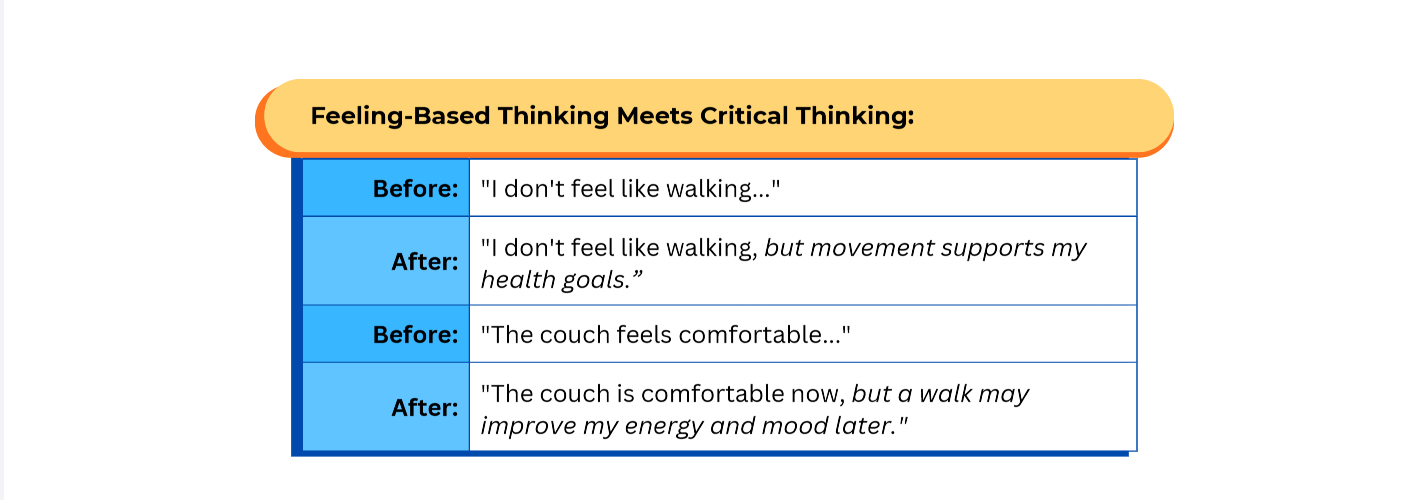
Feeling-based thinking can turn wellness decisions into internal battles when we filter objective facts through our emotional state. For example, you may plan to go for a walk after work but end up sitting on the couch instead because you feel exhausted. While those feelings are valid, they shouldn't be the only factor guiding your decision. Feelings provide insight into what matters to us. Critical thinking helps us determine the best way to act on those feelings.
By applying critical thinking strategies, such as weighing the pros and cons alongside our values, we can make choices that align with the outcomes we desire. When we balance both approaches, we're more likely to make decisions that support our values, goals, and overall well-being.
Below are a few examples of how critical thinking can help us take meaningful action toward our wellness goals:
| The Pros and Cons Strategy:
In-the-Moment Methods for Critical Thinking
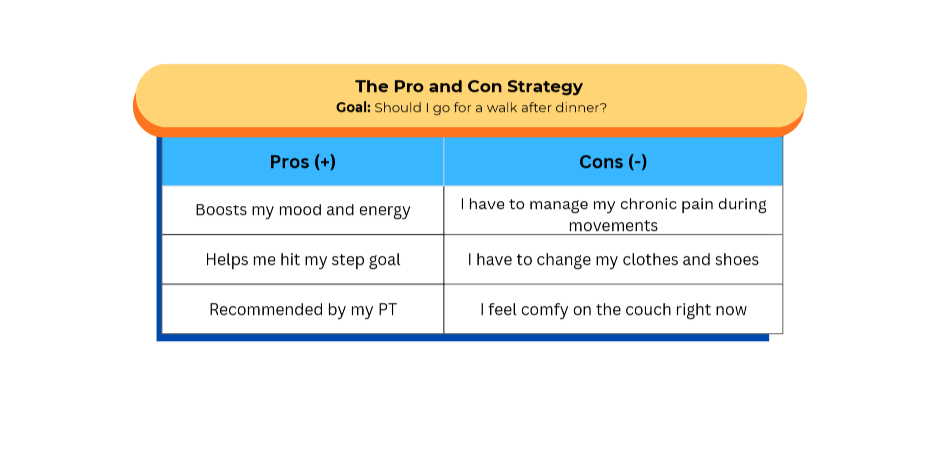
Small moments of thoughtful decision-making add up over time. By using a logical approach to evaluate choices, you can turn healthy intentions into lasting habits and meaningful progress toward well-being goals. Use The Pro and Con Strategy to evaluate the benefits, costs, risks, and opportunities in a potentially difficult wellness decision. This exercise takes less than a minute:
Draw a line: Take a piece of paper and draw a line down the middle.
Label the columns: Write Pros (positives) on the left and Cons (negatives) on the right. “Pros” add or provide a benefit, or advantages, while “cons” are thought of as consequences, drawbacks, or disadvantages.
Note: Consider both the short and long-term outcomes.
Brainstorm: Write down everything that comes to mind without filtering.
Compare: Review both sides visually to weigh the potential outcomes, leveraging logic to help you in an integrated decision-making approach.
Be honest: Write down your real feelings, even the silly ones.
Keep it short: Use simple bullet points instead of long paragraphs.
Look at impact logically: Keep in mind our logical approach, not letting “cons” outweigh “pros” just because we are feeling anxious about them! At the same time, know that one big "con" can sometimes outweigh three tiny "pros” still too.
In closing, Critical thinking isn't about finding a perfect decision. It's about making thoughtful choices in our daily habits by considering values, weighing the pros and cons, and balancing feelings and facts.